Physical Address
304 North Cardinal St.
Dorchester Center, MA 02124
Physical Address
304 North Cardinal St.
Dorchester Center, MA 02124

If you’ve ever wondered how professional developers build complex, scalable software systems, the answer often lies in one powerful concept: C++ Classes and Objects. Object-Oriented Programming (OOP) revolutionized the way we think about code — transforming messy, tangled scripts into organized, reusable, and maintainable architectures. Whether you’re a complete beginner stepping into C++ for the first time or an experienced developer looking to sharpen your OOP skills, understanding classes and objects is absolutely non-negotiable. This guide breaks everything down clearly, practically, and deeply — with real code examples, expert tips, and actionable insights you can apply immediately.
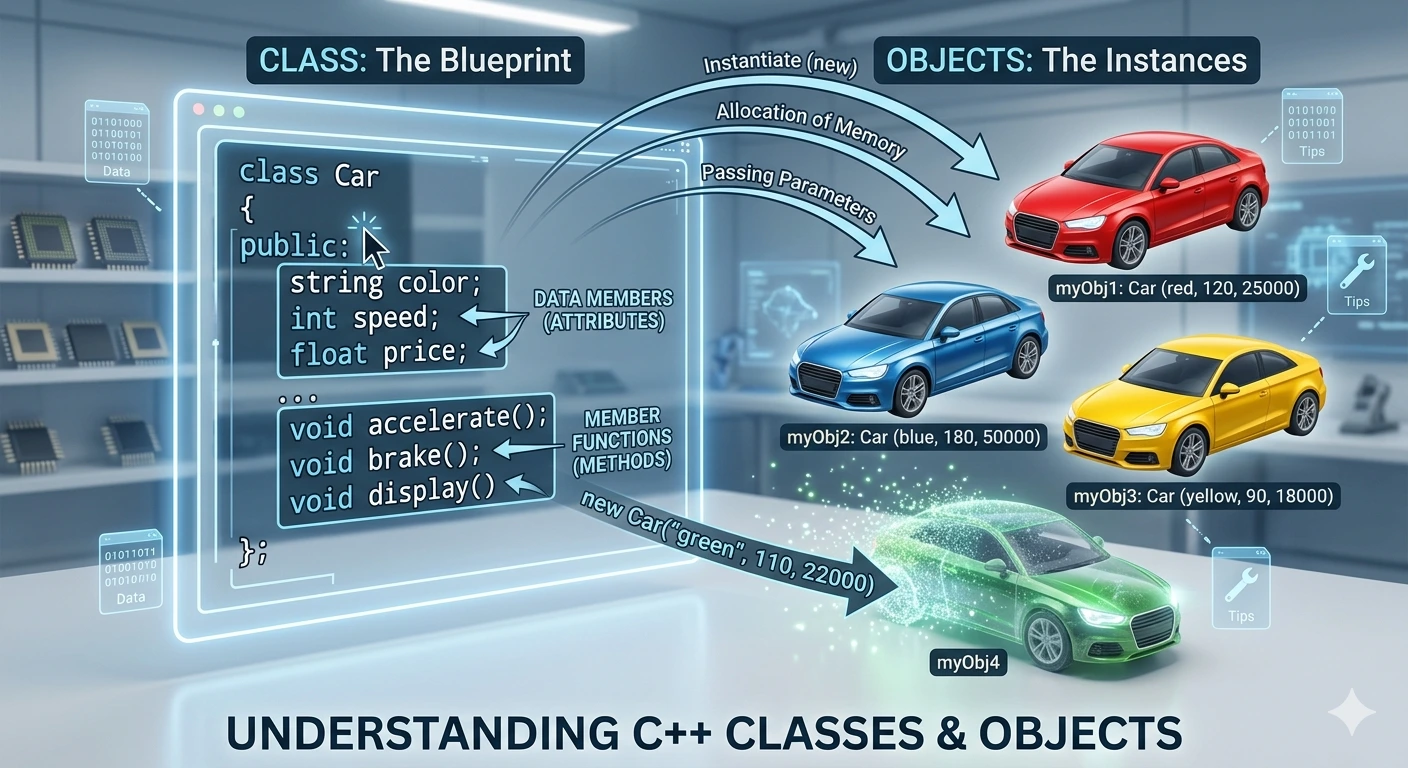
To truly understand C++ classes and objects, you need to appreciate the problem they were designed to solve. Back in the 1960s and 1970s, programming was almost entirely procedural — code was written as a sequence of instructions, functions operated on shared global data, and as programs grew larger, maintaining them became an absolute nightmare.
The concept of object-oriented programming (OOP) was pioneered by Ole-Johan Dahl and Kristen Nygaard in the language Simula (1967), which introduced the idea of grouping data and behavior together. Alan Kay later popularized the term “object-oriented” while developing Smalltalk at Xerox PARC in the 1970s.
Bjarne Stroustrup created C++ in 1979 at Bell Labs, originally calling it “C with Classes.” His motivation was simple but powerful: he wanted the efficiency and low-level control of C combined with the high-level abstraction capabilities of languages like Simula. The first commercial release of C++ came in 1985, and it fundamentally changed software development forever.
Here’s a brief evolutionary timeline:
| Year | Milestone |
|---|---|
| 1967 | Simula introduces classes and objects for the first time |
| 1979 | Bjarne Stroustrup begins work on “C with Classes” |
| 1983 | Language officially renamed C++ |
| 1985 | First commercial release of C++ |
| 1998 | C++98 — First ISO standardized version |
| 2011 | C++11 — Major modernization (smart pointers, lambdas, move semantics) |
| 2014 | C++14 — Bug fixes and small improvements |
| 2017 | C++17 — Structured bindings, filesystem, parallel algorithms |
| 2020 | C++20 — Concepts, ranges, coroutines |
| 2023 | C++23 — Further refinements and additions |
A class is a user-defined data type that acts as a blueprint for creating objects. It encapsulates data members (attributes) and member functions (methods) into a single logical unit.
class Car {
public:
    // Data Members (Attributes)
    string brand;
    string model;
    int year;

    // Member Function (Method)
    void displayInfo() {
        cout << "Brand: " << brand << endl;
        cout << "Model: " << model << endl;
        cout << "Year: " << year << endl;
    }
};An object is a specific instance of a class. If the class is the blueprint, the object is the actual house built from that blueprint. You can create multiple objects from the same class, and each object maintains its own copy of the data members.
int main() {
    // Creating objects of the Car class
    Car car1;
    car1.brand = "Toyota";
    car1.model = "Corolla";
    car1.year = 2022;
    car1.displayInfo();

    Car car2;
    car2.brand = "Honda";
    car2.model = "Civic";
    car2.year = 2023;
    car2.displayInfo();

    return 0;
}
Output:
Brand: Toyota
Model: Corolla
Year: 2022
Brand: Honda
Model: Civic
Year: 2023
Notice how car1 and car2 are two completely separate entities, each with their own data — this is the magic of objects.
Why C++ Classes and Objects Matter in 2026You might ask, “With so many modern languages like Python, Rust, and Go available, why should I care about C++ classes in 2026?” The answer is compelling and data-backed.
According to the TIOBE Index 2024, C++ consistently ranks in the top 3 programming languages globally. It powers:
std::unique_ptr and std::shared_ptr within class designs replace raw pointers for safer memory management.| Feature | Class | Struct | Union |
|---|---|---|---|
| Default Access Specifier | Private | Public | Public |
| Supports Inheritance | Yes | Yes (limited use) | No |
| Supports Member Functions | Yes | Yes | Yes |
| Encapsulation | Full | Partial | None |
| Memory Allocation | Separate memory per object | Separate memory per member | Shared memory for all members |
| Use Case | Complex OOP design | Simple data grouping | Memory-efficient variants |
| Constructor/Destructor | Fully supported | Supported | Partially supported |
| Polymorphism | Fully supported | Limited | Not supported |
| Access Control | Full (public/private/protected) | Mostly public | Mostly public |
| Best For | OOP systems, game dev, enterprise apps | C-style data aggregation, POD types | Low-level, hardware-interface programming |
| OOP Pillar | C++ Keyword/Mechanism | Real-World Analogy | Example Use Case |
|---|---|---|---|
| Encapsulation | private, public, protected |
A capsule hiding medicine | Hiding internal bank account logic |
| Inheritance | : public BaseClass |
Child inheriting parent’s traits | ElectricCar inheriting from Car |
| Polymorphism | virtual, function overloading |
One remote controlling multiple TVs | Drawing different shapes with one draw() call |
| Abstraction | Abstract classes, pure virtual functions | A car’s steering wheel hiding engine complexity | Interface for database connections |
A constructor is a special member function automatically called when an object is created. A destructor is called when the object is destroyed.
#include <iostream>
#include <string>
using namespace std;

class BankAccount {
private:
    string owner;
    double balance;

public:
    // Constructor
    BankAccount(string name, double initialBalance) {
        owner = name;
        balance = initialBalance;
        cout << "Account created for: " << owner << endl;
    }

    // Destructor
    ~BankAccount() {
        cout << "Account closed for: " << owner << endl;
    }

    // Member Functions
    void deposit(double amount) {
        if (amount > 0) {
            balance += amount;
            cout << "Deposited: $" << amount << " | New Balance: $" << balance << endl;
        }
    }

    void withdraw(double amount) {
        if (amount > balance) {
            cout << "Insufficient funds!" << endl;
        } else {
            balance -= amount;
            cout << "Withdrawn: $" << amount << " | New Balance: $" << balance << endl;
        }
    }

    void displayBalance() {
        cout << owner << "'s Balance: $" << balance << endl;
    }
};

int main() {
    BankAccount acc1("Alice", 1000.00);
    acc1.deposit(500.00);
    acc1.withdraw(200.00);
    acc1.displayBalance();

    return 0;
}
Output:
Account created for: Alice
Deposited: $500 | New Balance: $1500
Withdrawn: $200 | New Balance: $1300
Alice's Balance: $1300
Account closed for: Alice
💡 Pro-Tip: Always define a destructor if your class manages dynamic memory (uses
new). This prevents memory leaks — one of the most common and insidious bugs in C++ programs.
Access specifiers are the backbone of encapsulation in C++. They control who can access what inside a class.
public: Accessible from anywhere in the program.private: Accessible only within the class itself. Default for class members.protected: Accessible within the class and its derived classes.
class Employee {
private:
    double salary;      // Cannot be accessed directly outside

protected:
    string department;  // Accessible in derived classes

public:
    string name;        // Freely accessible

    void setSalary(double s) {
        if (s > 0) salary = s;  // Controlled access through method
    }

    double getSalary() {
        return salary;
    }
};Inheritance allows a new class (derived class) to acquire properties and behaviors of an existing class (base class), promoting code reusability.
#include <iostream>
#include <string>
using namespace std;

// Base Class
class Vehicle {
public:
    string brand;
    int speed;

    Vehicle(string b, int s) : brand(b), speed(s) {}

    void displayDetails() {
        cout << "Brand: " << brand << " | Max Speed: " << speed << " km/h" << endl;
    }
};

// Derived Class
class ElectricVehicle : public Vehicle {
public:
    int batteryRange; // in km

    ElectricVehicle(string b, int s, int range)
        : Vehicle(b, s), batteryRange(range) {}

    void displayEVDetails() {
        displayDetails(); // Calling base class method
        cout << "Battery Range: " << batteryRange << " km" << endl;
    }
};

int main() {
    ElectricVehicle tesla("Tesla Model 3", 250, 570);
    tesla.displayEVDetails();
    return 0;
}
Output:
Brand: Tesla Model 3 | Max Speed: 250 km/h
Battery Range: 570 kmPolymorphism means “many forms.” In C++, it’s achieved through function overloading (compile-time) and virtual functions (runtime).
#include <iostream>
using namespace std;

class Shape {
public:
    virtual void draw() {
        cout << "Drawing a generic shape" << endl;
    }
    virtual double area() = 0; // Pure virtual function — makes Shape abstract
};

class Circle : public Shape {
    double radius;
public:
    Circle(double r) : radius(r) {}
    void draw() override {
        cout << "Drawing a Circle" << endl;
    }
    double area() override {
        return 3.14159 * radius * radius;
    }
};

class Rectangle : public Shape {
    double width, height;
public:
    Rectangle(double w, double h) : width(w), height(h) {}
    void draw() override {
        cout << "Drawing a Rectangle" << endl;
    }
    double area() override {
        return width * height;
    }
};

int main() {
    Shape* shapes[2];
    shapes[0] = new Circle(5.0);
    shapes[1] = new Rectangle(4.0, 6.0);

    for (int i = 0; i < 2; i++) {
        shapes[i]->draw();
        cout << "Area: " << shapes[i]->area() << endl;
    }

    delete shapes[0];
    delete shapes[1];
    return 0;
}
Output:
Drawing a Circle
Area: 78.5397
Drawing a Rectangle
Area: 24
#include <iostream>
using namespace std;

class Point {
private:
    int x, y;

public:
    Point(int x = 0, int y = 0) : x(x), y(y) {}

    // Operator overloading for +
    Point operator+(const Point& p) {
        return Point(x + p.x, y + p.y);
    }

    // Friend function for output
    friend ostream& operator<<(ostream& out, const Point& p) {
        out << "(" << p.x << ", " << p.y << ")";
        return out;
    }
};

int main() {
    Point p1(3, 4);
    Point p2(1, 2);
    Point p3 = p1 + p2;
    cout << "P1: " << p1 << endl;
    cout << "P2: " << p2 << endl;
    cout << "P3 (P1 + P2): " << p3 << endl;
    return 0;
}
#include <iostream>
using namespace std;

template <typename T>
class Stack {
private:
    T arr[100];
    int top;

public:
    Stack() : top(-1) {}

    void push(T value) {
        arr[++top] = value;
        cout << value << " pushed to stack." << endl;
    }

    T pop() {
        if (top < 0) {
            cout << "Stack underflow!" << endl;
            return T();
        }
        return arr[top--];
    }

    bool isEmpty() { return top < 0; }
};

int main() {
    Stack<int> intStack;
    intStack.push(10);
    intStack.push(20);
    cout << "Popped: " << intStack.pop() << endl;

    Stack<string> strStack;
    strStack.push("Hello");
    strStack.push("World");
    cout << "Popped: " << strStack.pop() << endl;

    return 0;
}.h file.cpp file
// Preferred
BankAccount(string name, double bal) : owner(name), balance(bal) {}

// Less efficient (assigns after default initialization)
BankAccount(string name, double bal) {
    owner = name;
    balance = bal;
}const member functions for read-only operations:
double getBalance() const { return balance; }explicit keyword to prevent unintended implicit conversions:
explicit BankAccount(double initialBalance);💡 Pro-Tip #1: Always make your data members
privateby default. Public data members break encapsulation and make future refactoring extremely painful.
💡 Pro-Tip #2: Use
nullptrinstead ofNULLor0when working with pointers inside classes. It’s type-safe and unambiguous.
💡 Pro-Tip #3: When using inheritance, make your base class destructors
virtualto ensure proper cleanup of derived class objects.
💡 Pro-Tip #4: Prefer composition over inheritance when the relationship is “has-a” rather than “is-a.” Overusing inheritance leads to fragile, tightly coupled code.
💡 Pro-Tip #5: Use
overridekeyword explicitly when overriding virtual functions. It enables the compiler to catch typos and signature mismatches at compile time.
// WRONG
void createObject() {
    MyClass* obj = new MyClass();
    // obj is never deleted — memory leak!
}

// RIGHT — Use smart pointers
void createObject() {
    auto obj = std::make_unique<MyClass>();
    // Automatically deleted when out of scope
}
// WRONG — Undefined behavior when deleting through base pointer
class Base {
public:
    ~Base() { cout << "Base destroyed" << endl; }
};

// RIGHT
class Base {
public:
    virtual ~Base() { cout << "Base destroyed" << endl; }
};
// WRONG — Derived class data is "sliced off"
Derived d;
Base b = d; // Object slicing occurs!

// RIGHT — Use pointers or references
Base* b = &d; // No slicing
Base& bRef = d; // No slicing
// WRONG — Dangling reference
string& getName() {
    string name = "Alice";
    return name; // Undefined behavior!
}

// RIGHT
string getName() {
    return "Alice"; // Return by value
}
// WRONG — Virtual dispatch doesn't work in constructors
class Base {
public:
    Base() { initialize(); } // Calls Base::initialize(), not Derived::initialize()
    virtual void initialize() {}
};Problem: In complex systems with many interconnected objects, managing who owns what memory becomes incredibly difficult. Memory leaks and dangling pointers are constant threats.
Solution: Adopt RAII (Resource Acquisition Is Initialization) and modern smart pointers:
#include <memory>

class ResourceManager {
private:
    std::unique_ptr<int[]> data;
    size_t size;

public:
    ResourceManager(size_t n) : data(std::make_unique<int[]>(n)), size(n) {
        cout << "Resource acquired" << endl;
    }
    // No need for explicit destructor — unique_ptr handles it

    int& operator[](size_t index) { return data[index]; }
};Problem: When a class contains pointer members and you use the default copy constructor, both the original and copy point to the same memory — a ticking time bomb.
Solution: Implement a proper deep copy constructor:
class Matrix {
private:
    int** data;
    int rows, cols;

public:
    // Deep Copy Constructor
    Matrix(const Matrix& other) : rows(other.rows), cols(other.cols) {
        data = new int*[rows];
        for (int i = 0; i < rows; i++) {
            data[i] = new int[cols];
            for (int j = 0; j < cols; j++) {
                data[i][j] = other.data[i][j]; // Copy actual values
            }
        }
    }
};Problem: When a class inherits from two classes that both inherit from the same base, you get ambiguity and duplicate data.
Solution: Use virtual inheritance:
class Animal {
public:
    string name;
};

class Dog : virtual public Animal {}; // virtual inheritance
class Cat : virtual public Animal {}; // virtual inheritance

class HybridPet : public Dog, public Cat {
    // Only ONE copy of Animal's data — problem solved!
};Problem: Virtual function calls have overhead due to vtable lookups, which can matter in performance-critical loops.
Solution: Use CRTP (Curiously Recurring Template Pattern) for compile-time polymorphism when runtime polymorphism isn’t needed:
template <typename Derived>
class Shape {
public:
    void draw() {
        static_cast<Derived*>(this)->drawImpl();
    }
};

class Circle : public Shape<Circle> {
public:
    void drawImpl() {
        cout << "Drawing Circle" << endl;
    }
};
This achieves polymorphic behavior with zero runtime overhead.
A class is a blueprint or template that defines the structure and behavior of a type — it specifies what data members and member functions exist. An object is a concrete instance of that class, occupying actual memory at runtime. Think of it like a cookie cutter (class) versus the actual cookies (objects). You define a class once and can create as many objects from it as you need, each with its own independent data.
Absolutely! This is called constructor overloading, and it’s one of C++’s most powerful features. You can define multiple constructors with different parameter lists, allowing objects to be created in various ways:
class Rectangle {
public:
    double width, height;
    Rectangle() : width(1.0), height(1.0) {}              // Default
    Rectangle(double w, double h) : width(w), height(h) {} // Parameterized
    Rectangle(double side) : width(side), height(side) {}  // Square
};
C++11 also introduced delegating constructors, which allow one constructor to call another within the same class.
These are access specifiers that control visibility:
public: Members are accessible from anywhere — inside the class, from derived classes, and from external code.private: Members are accessible only within the class itself. Not even derived classes can access them directly. This is the default access level for class members.protected: Members are accessible within the class and its derived (child) classes, but not from external code. This enables a balance between encapsulation and inheritance.Operator overloading allows you to redefine how standard C++ operators (+, -, *, <<, ==, etc.) work with your custom class types. This makes your classes more intuitive and natural to use. For example, without overloading, you’d write point1.add(point2), but with operator overloading you can simply write point1 + point2, making the code far more readable and expressive. It’s especially useful in mathematical classes (vectors, matrices, complex numbers) and I/O operations.
This is one of the most important architectural decisions in OOP:
Dog is-a Animal, ElectricCar is-a Car.Car has-a Engine, BankAccount has-a Customer.General rule: Prefer composition over inheritance. Composition produces more flexible, loosely coupled designs. Overusing inheritance creates deep, rigid hierarchies that are difficult to change and maintain. The famous Gang of Four design patterns book explicitly recommends this approach.
An abstract class is a class that cannot be instantiated directly — it exists purely to be inherited from. It contains at least one pure virtual function, declared with = 0 syntax:
class AbstractShape {
public:
    virtual double area() = 0;   // Pure virtual function
    virtual void draw() = 0;     // Pure virtual function
    virtual ~AbstractShape() {}
};
Any class that inherits from AbstractShape must implement both area() and draw(), or it too becomes abstract. This enforces a contract — it’s C++’s way of defining interfaces, similar to interface keywords in Java or C#.
Congratulations on making it through this comprehensive guide on C++ classes and objects! You’ve covered an incredible amount of ground — from understanding the historical roots of OOP and Bjarne Stroustrup’s vision, all the way through constructors, destructors, access specifiers, inheritance, polymorphism, templates, operator overloading, and advanced design patterns.
Here’s what makes this knowledge truly exciting: every concept you’ve learned here transfers directly into real-world software development. The encapsulation patterns you’ve practiced are the same ones used in game engines. The virtual function techniques apply directly to building plugin systems and extensible architectures. The RAII patterns you’ve absorbed are considered the gold standard for writing safe, leak-free C++ code in professional environments.