


Introduction
Learning to code has never been more accessible — or more exciting — than it is right now. Whether you’re a complete beginner or a seasoned developer looking to pick up a new language, understanding how to learn coding with AI can dramatically compress your learning curve. Artificial intelligence tools are reshaping education at every level, offering personalized feedback, instant debugging help, real-time explanations, and interactive coding challenges that traditional textbooks simply cannot match. In this comprehensive guide, we’ll walk you through exactly how to harness AI-powered tools to accelerate your programming journey, avoid common pitfalls, and build skills that actually stick — all backed by data, expert insights, and real-world examples.
What Is Programming? (History & Evolution)
The Origins of Programming
Programming, at its core, is the art and science of giving instructions to a computer. These instructions, written in a specific language a machine can interpret, allow humans to build software, automate tasks, and solve complex problems. The history of programming stretches back further than most people realize.
- 1840s: Ada Lovelace is widely credited as the world’s first programmer, writing an algorithm for Charles Babbage’s proposed Analytical Engine.
- 1940s–1950s: Early computers like ENIAC were programmed using punch cards and machine code — tedious, error-prone, and accessible only to specialists.
- 1957: FORTRAN, the first high-level programming language, was introduced by IBM, making programming dramatically more human-readable.
- 1970s–1980s: Languages like C, Pascal, and BASIC democratized programming, enabling a new generation of hobbyists and professionals.
- 1990s: The rise of the internet brought HTML, JavaScript, and Python into the spotlight.
- 2000s–2010s: Object-oriented programming became mainstream, and frameworks like Ruby on Rails, Django, and React transformed web development.
- 2020s–present: AI-powered tools, low-code platforms, and intelligent IDEs have begun changing how we learn and write code entirely.
The Evolution of How We Learn to Code
Traditional programming education relied on:
- Dense textbooks and documentation
- Classroom instruction
- Trial-and-error debugging
- Stack Overflow searches and forum posts
These methods work — but they’re slow, often frustrating, and rarely personalized. Enter artificial intelligence. Today’s AI models can act as a patient tutor, a debugging partner, a code reviewer, and a project idea generator — all in one.
According to Wikipedia’s entry on Programming Languages, there are over 700 programming languages in existence today. Knowing which to learn, and how to learn efficiently, is where AI becomes a game-changer.
Why Using AI to Learn Programming Faster Matters in 2026 (Current Trends)
The Demand for Developers Is Skyrocketing
The U.S. Bureau of Labor Statistics projects software development jobs to grow 25% between 2022 and 2032 — much faster than the average for all occupations. Meanwhile, the global developer shortage is estimated to reach 4 million unfilled positions by 2025.
The pressure is on. Companies need skilled programmers now, not in three to five years after traditional education runs its course. This is exactly why learning how to use AI to learn programming faster has gone from a nice-to-have to an essential strategy.
Key 2026 Trends Driving AI-Powered Learning
- Conversational AI Tutors: Tools like ChatGPT, Claude, and Gemini can explain any concept in plain English, generate examples, and quiz you interactively.
- AI Code Assistants: GitHub Copilot, Tabnine, and Amazon CodeWhisperer write, complete, and review code in real time.
- Adaptive Learning Platforms: Platforms like Codecademy, DataCamp, and Brilliant are embedding AI to personalize lesson paths.
- AI Debugging Tools: Tools that analyze error messages and suggest precise fixes, dramatically reducing frustration for beginners.
- Natural Language to Code: In 2026, typing a plain-English description and getting working code back has become routine — and learning to work with this capability is itself a skill.
What the Data Says
A 2023 GitHub survey found that developers using GitHub Copilot completed coding tasks 55% faster than those who didn’t. Separate studies from Stanford found that AI-assisted programming education improved student outcomes by up to 40% compared to traditional self-study.
These numbers aren’t just impressive — they’re transformational.

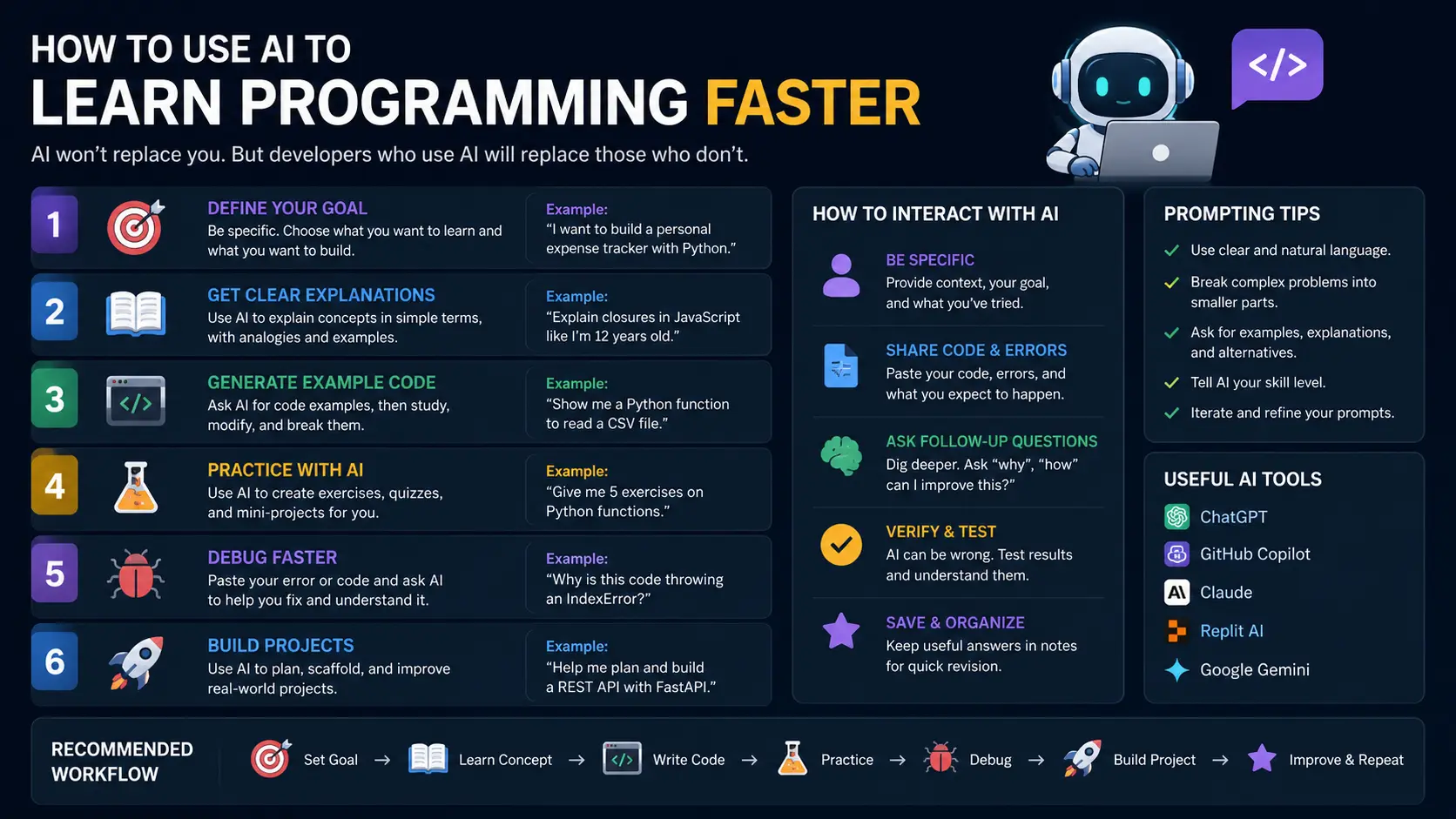
Detailed Comparison: AI Learning Tools vs. Traditional Learning Methods
Table 1: AI-Powered Tools vs. Traditional Programming Learning Methods
| Feature | Traditional Learning | AI-Assisted Learning |
|---|---|---|
| Personalization | Low (one-size-fits-all) | High (adapts to your level) |
| Feedback Speed | Slow (forums, instructors) | Instant |
| Cost | Medium–High (courses, bootcamps) | Low–Free (many AI tools are free) |
| Availability | Limited (scheduled classes) | 24/7 on-demand |
| Debugging Help | Manual, time-consuming | Automated, precise |
| Code Review | Peer or instructor only | AI + peer options |
| Project Ideas | Limited to curriculum | Unlimited, customized |
| Language Support | Fixed curriculum language | Any language, any level |
| Learning Curve | Steep without guidance | Gentler with AI scaffolding |
| Engagement | Passive (reading/watching) | Interactive and conversational |
Table 2: Top AI Coding Tools Compared
| Tool | Best For | Price | Languages Supported | Standout Feature |
|---|---|---|---|---|
| GitHub Copilot | Code completion & suggestions | $10/month | 30+ | Real-time in-IDE suggestions |
| ChatGPT (GPT-4o) | Explanations, tutoring, debugging | Free / $20 mo | All major languages | Conversational depth |
| Claude (Anthropic) | Long code reviews, explanations | Free / $20 mo | All major languages | Nuanced reasoning |
| Tabnine | Autocomplete in IDE | Free / $12 mo | 30+ | Privacy-focused, local AI |
| Replit AI | Beginners, project building | Free / $20 mo | 50+ | Browser-based IDE + AI |
| Codecademy AI | Structured curriculum with AI hints | $17/month | Python, JS, SQL, more | Guided learning paths |
| Codeium | Free Copilot alternative | Free | 70+ | Zero cost, broad support |
Step-by-Step Practical Guide: How to Use AI to Learn Programming Faster
Step 1: Define Your Learning Goal Clearly
Before firing up any AI tool, get specific about what you want to achieve. Vague goals produce vague results.
Bad goal: “I want to learn Python.”
Good goal: “I want to build a web scraper in Python within 30 days to automate data collection for my business.”
Once you have a concrete goal, your AI tutor can:
- Recommend the exact concepts to focus on
- Generate project-specific examples
- Skip irrelevant topics that don’t serve your goal
Pro-Tip: Paste your learning goal into ChatGPT and ask it to create a 30-day structured learning plan. It will outline daily topics, recommend resources, and even suggest mini-projects along the way.
Step 2: Use AI as Your Personal Tutor — Not Just a Search Engine
Most beginners make the mistake of treating AI like a fancier Google. The real power comes from conversation.
Here’s how to engage AI effectively for learning:
- Ask for explanations at your level: “Explain recursion to me like I’m a 12-year-old, then give me a real Python example.”
- Request multiple approaches: “Show me three different ways to loop through a list in Python and explain when to use each.”
- Test your understanding: “Quiz me on Python list comprehensions with five questions of increasing difficulty.”
- Dig into confusing concepts: “I still don’t understand why
selfis used in Python classes. Can you walk me through it step by step?”
This conversational loop — question, explanation, example, quiz — is far more effective than passively watching tutorial videos.
Step 3: Build Real Projects Immediately
One of the biggest mistakes new programmers make is spending too long on tutorials before building anything real. AI solves this perfectly.
Use AI to scaffold your first project:
- Describe your project idea to ChatGPT or Claude in plain English
- Ask it to outline the project structure and key files needed
- Build each component with AI assistance — but write the code yourself first, then compare
- Use AI to review your code and suggest improvements
- Ask “what could go wrong with this code?” to learn defensive programming
Example Project Progression:
- Week 1–2: Build a to-do list app (variables, functions, lists)
- Week 3–4: Build a weather data fetcher (APIs, JSON parsing)
- Week 5–6: Build a simple web scraper (libraries, error handling)
- Week 7–8: Build a basic CRUD web app (databases, frameworks)
Each project teaches concepts in context, and AI keeps you unblocked when you get stuck.
Step 4: Use AI for Debugging Like a Pro
Debugging is where beginners spend most of their time — and where frustration peaks. AI is remarkably good at this.
How to debug effectively with AI:
- Copy your error message and the relevant code into the AI chat
- Ask: “Explain what this error means and why it’s happening”
- Don’t just accept the fix — ask: “Why was my original approach wrong?”
- Follow up: “What’s the best practice to prevent this error in the future?”
This approach turns every bug into a learning moment rather than just a problem to eliminate.
Step 5: Do Regular Code Reviews with AI
As your projects grow, code quality becomes critical. Use AI as a code reviewer:
- Paste a function or block of code and ask: “Review this code for efficiency, readability, and best practices”
- Ask: “How would a senior developer rewrite this?”
- Request specific feedback: “Check this for security vulnerabilities” or “Is this Pythonic?”
Pro-Tip: Compare your code side-by-side with AI’s improved version. Study the differences line by line — this is one of the fastest ways to level up your code quality.
Step 6: Supplement with Structured Resources
AI is powerful, but it works best alongside structured learning, not in isolation. Use it to complement:
- Official documentation (e.g., Python Docs)
- Platforms like freeCodeCamp, The Odin Project, or Codecademy
- Video courses on Udemy or Coursera for visual learners
When you hit a concept in your course that’s confusing, immediately bring it to your AI tutor for a deeper explanation with custom examples.
Best Practices & Expert Tips
Best Practices for AI-Accelerated Programming Learning
- Always write code before asking AI: Attempt the problem first, then use AI to check or improve your solution. This builds real understanding.
- Ask “why,” not just “what”: Don’t just get the answer — understand the reasoning behind it.
- Use AI to generate deliberate practice: Ask for progressively harder exercises on the same concept.
- Build a learning journal: After each AI session, write a brief summary of what you learned in your own words.
- Vary your AI tools: Use Copilot for in-IDE coding, ChatGPT for explanations, and Replit AI for quick experiments.
- Review AI-generated code critically: AI can and does make mistakes. Treat its output as a starting point, not gospel.
Common Mistakes to Avoid
❌ Copy-pasting AI code without understanding it — You’ll hit a wall the moment you need to modify or debug it.
❌ Relying on AI for every line — This prevents muscle memory and deep understanding from forming.
❌ Skipping fundamentals — AI can’t replace your understanding of core concepts like data structures, algorithms, and logic.
❌ Using AI as a crutch instead of a coach — Ask it to guide you, not do the work for you.
❌ Ignoring error messages — Don’t immediately paste errors into AI. Spend 5 minutes reading and researching the error yourself first.
❌ Not validating AI responses — Always test code in your environment. AI can generate plausible-looking but incorrect solutions.
Challenges and Solutions
Challenge 1: AI Produces Incorrect or Outdated Code
The Problem: AI models have training cutoffs and can generate code that’s deprecated, incorrect, or inefficient.
The Solution:
- Always test AI-generated code in your own environment
- Cross-reference with official documentation (e.g., MDN Web Docs)
- Ask the AI: “Is this the most current way to do this in [language version X]?”
Challenge 2: Over-Dependence on AI Assistance
The Problem: Beginners who lean too heavily on AI never develop independent problem-solving skills — a critical quality for real-world employment.
The Solution:
- Implement a “struggle first” rule: spend at least 15 minutes on a problem before asking AI
- Practice on platforms like LeetCode, HackerRank, or Codewars without AI assistance
- Use AI to review your independent solutions afterward, not to generate them
Challenge 3: Information Overload
The Problem: AI can generate an overwhelming amount of information, leading to confusion rather than clarity.
The Solution:
- Ask focused, single-concept questions rather than broad ones
- Request “the most important thing I need to know right now” framing
- Stick to one learning resource or curriculum, and use AI to supplement it — not replace it
Challenge 4: Lack of Accountability and Structure
The Problem: Self-directed AI learning lacks the accountability structure of a formal course or bootcamp.
The Solution:
- Ask your AI tutor to create a structured weekly syllabus
- Join coding communities on Discord, Reddit (r/learnprogramming), or local meetups
- Set weekly project milestones and review progress with AI at the end of each week
Challenge 5: Knowing Which AI Tool to Use When
The Problem: With so many AI tools available, beginners often feel paralyzed or waste time switching between platforms.
The Solution: Use the simple framework below:
| Task | Best Tool |
|---|---|
| Learning a new concept | ChatGPT / Claude |
| Writing code faster in your IDE | GitHub Copilot / Codeium |
| Building and running a project | Replit AI |
| Structured curriculum + hints | Codecademy AI |
| Code autocomplete (privacy-focused) | Tabnine |
Frequently Asked Questions (FAQ)
#### Q1: Can a complete beginner use AI to learn programming from scratch?
Absolutely. In fact, AI tools like ChatGPT and Replit AI are particularly well-suited for complete beginners because they can explain concepts from the ground up, adjust the difficulty based on your questions, and never make you feel judged for asking “basic” questions. Start with a beginner-friendly language like Python, set a clear goal, and use AI as your patient, always-available tutor.
#### Q2: Will using AI to code make me a worse programmer?
Only if you use it passively. If you copy-paste AI-generated code without understanding it, yes — your skills won’t develop. But if you use AI as a coach (to explain, quiz, review, and guide), it will make you a significantly better programmer by accelerating your exposure to best practices, diverse approaches, and clean code principles.
#### Q3: Which programming language should I learn first with AI assistance?
Python remains the top recommendation in 2026 for most learners because:
- It has simple, readable syntax that’s beginner-friendly
- It’s used in web development, data science, AI/ML, and automation
- AI tools are exceptionally well-trained on Python code
- The community and resource ecosystem are massive
JavaScript is a close second, especially if your goal is web development.
#### Q4: How long does it take to learn programming with AI help?
With consistent daily practice (1–2 hours/day) and effective AI-assisted learning, most dedicated beginners can:
- Write basic working programs in 4–6 weeks
- Build small real-world projects in 2–3 months
- Be job-ready (junior level) in 6–12 months
AI can compress these timelines by 30–50% compared to traditional self-study, but consistent practice is still the deciding factor.
#### Q5: Is it ethical to use AI when learning to code?
Yes — using AI as a learning tool is completely ethical. It’s no different from using a textbook, a tutor, or Stack Overflow. The key distinction is intent: using AI to learn and understand is ethical; using AI to submit work as your own in academic settings without disclosure may violate academic integrity policies. Always check the rules of your institution or course. In the professional world, AI-assisted development is not only accepted — it’s increasingly expected.
#### Q6: What are the best free AI tools for learning programming?
Several excellent free options exist in 2026:
- ChatGPT (free tier) — Explanations, tutoring, debugging
- Codeium — Free AI code completion for your IDE
- Replit (free plan) — Browser-based coding with AI assistance
- GitHub Copilot (free for students) — Full AI code assistant
- Google Gemini — Code explanations and generation
Conclusion: Your AI-Powered Coding Journey Starts Now
The landscape of programming education has been permanently and profoundly transformed. Learning to code in 2026 doesn’t have to mean spending thousands of dollars on bootcamps, wading through outdated textbooks, or spending hours stuck on a single error with no one to ask. With the right AI tools and strategies, you can learn faster, build sooner, and grow more confidently than any previous generation of programmers.
Here’s your action plan to get started today:
- ✅ Choose your language (Python is your best first bet)
- ✅ Set a clear, project-based goal (not just “learn Python,” but “build X by date Y”)
- ✅ Set up your AI toolkit (ChatGPT + Codeium or Copilot is a great starting combo)
- ✅ Follow a structured curriculum and use AI to go deeper on every concept
- ✅ Build real projects from week one, using AI as scaffolding — not a shortcut
- ✅ Practice independently on platforms like LeetCode and HackerRank regularly
- ✅ Review your code with AI weekly to accelerate your quality improvement
Remember: every expert programmer was once a beginner who got stuck, got confused, and kept going anyway. The difference today is that you have an extraordinary advantage they didn’t — an intelligent, patient, endlessly available learning partner in your corner.
You have everything you need. The only question is: when do you start?
The answer should be right now. 🚀
For further reading, explore the following high-authority resources: